Sunday, September 9, 2012

A Second Set


            The next set of poems had themes similar to the previous set, but this set also focused on the earth being separate from humans and being unwanted.
            The first poem, “For Nothing”, compared the earth to a flower staying in its natural environment. It is beautiful in its surroundings, but all of that is for nothing because nobody wants it. Snyder says that there are “no takers” because there are not many people who are trying to keep the earth and the environment in natural, pristine condition. While many people can appreciate the beautiful condition that the flower is in, there is no effort to take care of it and keep the flower safe.
            “It Pleases” is a poem about everything that happens because of people and animals, but how we are not the source of power of it all. In the setting of D.C., people are moving, buildings are standing, and birds are flying against the clouds. Although all of this is happening, the center of power is the earth. The earth is the power behind everything that is and was. And even though people try to control the earth, it still does what it pleases. We cannot stop all of the natural disasters of the world no matter how hard we try.
            In “Two Fawns that Didn’t See the Light this Spring”, Snyder describes two different situations that had very similar endings. In the first situation, a man shot what he thought was a buck, but ended up being a doe that was carrying a fawn. Both died. In the second situation, a man accidentally hit a doe with his car. This doe was also carrying a fawn that they found when they butchered it for meat.  Both of these fawns did not get to see the spring because their mothers were killed before their times. This poem is really only about how tragic life can be when it is cut short.


Wednesday, September 5, 2012

Snyder's Poems


            I had a very simple method of picking my poems. I started fairly close to the back of Turtle Island and flipped pages until finding a poem that I liked.
            Starting with “For the Children”, this poem is about how the human race is destroying the world more and more as we look for solutions on how fix what we have done. Mountains move in front of people as they continue to go down. Snyder mentions that people say that we will reach a place in the future where environmental problems won’t be a concern anymore, but we have to work to get there. He tells people to tell their children to “go light” and not destroy the world anymore in the process of trying to achieve salvation.
            “Dusty Braces” is about the men of a time before Snyder. These men were hard working, but they worked in environment destroying jobs. They were miners or railroad builders who destroyed land to make their honest mans’ pay. Snyder resents them for this. He calls them “bastards” because of what they have done to the planet while he has been a “tree hearted son” to these men and the earth.
            The poem “LMFBR” is about the monster destroying the world: industry. The “Liquid Metal Fast Breeder Reactor” is the name of this monster. It is behind industry and is described as having plutonium teeth. Snyder moves to talk about all the products that the LMFBR creates and how these products don’t just dissipate away, but stick with us. He refers to all that is happening because of industry as the “Kālī Yūga”, a final phase of destruction in an Indian spiritual belief system. This phase is marked by death, destruction, and demoralization of man and his spirituality. The products of the LMFBR only bring the yūga more power.
            “Affluence” is the final poem on my list for the time being. This poem is about forestry before Snyder’s time and about what people are having to do because of older forestry practices. Snyder describes how before, a logger would cut down trees and then just leave the land how it was. This makes it extremely difficult for anything to grow back because all of the space is taken up by dead tree trunks. A more modern forestry technique is the slash and burn technique in which trees are cut down and the trunks are burned so that the ashes provide nutrients for the coming saplings. This cost the older logger money that he didn’t want to spend, but now people are paying for something that should have been done long ago.

Tuesday, August 28, 2012

Reflection on McKibben

From a series of pod-casts and a bio-regional quiz that asks about surrounding areas and environmental questions that most people don't ever think about, a listener and quiz taker can feel out of touch with the surrounding world. McKibben is the guest in the series of pod-casts and talks about a world that is extremely different than the world of fifty years ago. McKibben calls this world Eaarth because of the amount of differences experienced around the planet through travels. McKibben explains that people in the world today want to solve all of the environmental problems by building bigger and more advanced technology  to do the work, but that should not be the goal of the people. People should go back to smaller quicker ways of fixing problems than the larger way that society is used to. Farming is one of the best ways to do this, but unfortunately, only a few people in the United States farm. Although many people don't farm, there are a lot of people that want to know more about the skill and how to keep gardens. In countries like Indonesia, there are entire schools that teach the public how to be better farmers and how to do the job. This kind of information can make a public feel out of touch with the land and disappointed not to be farming the world as well.

Thursday, August 23, 2012

Rainforest Deforestation


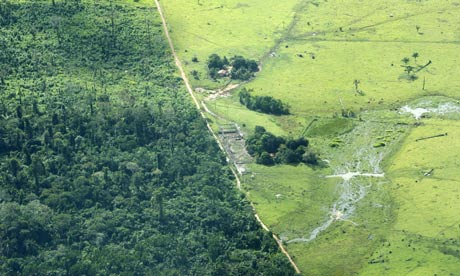
            Rainforests used to cover more than fifteen percent of the earth’s land surface, but today that number has been more than cut in half. Although it seems like a lot of the earth is covered, that number is rapidly decreasing because of human activity. People have done two things to destroy the rainforest: first, people cut down the trees and second, they move into the area that was cut down.
            As the human population grew through the second half of the twentieth century, the need for resources and land grew as well. People began taking to the rainforests all over the world because of all the space that they cover. And because the population continues to grow, people are taking more and more out of the forests. The Amazon in Brazil is the most deforested rainforest in the world. With one and a half acres of rainforest being lost every second on average, the Amazon could be lost entirely in the next forty years. The deforestation has been estimated to kill over 50,000 species of plants and animals a year and the number can only go up unless something is done about it. There has even been an entire tribe of people found in the rainforest that had never seen the outside world until deforestation destroyed their world. But deforestation is not the only thing destroying the rainforest, settlers and squatters do a lot of damage too.
            After the trees have been cut down and the land left barren, all nature wants to do is rebuild itself, but people move in and take the land for themselves. Squatters move in on the land to set up farms and homes without any land ownership. But the thing is, the government has been corrupted to a point that it doesn’t even matter whether or not people have land rights. This is the kind of stuff that makes it impossible for nature to take back what it once had. This is the reason for an island civilization.
            An island civilization would be completely separate from nature. People would no longer be in a place to interfere with the processes of nature. It could take back the world while people wait and watch from giant bubbles on land, in the sky, and under water.
            This is a good article that shows the kind of things that happen to the rainforest because of human interference http://environment.nationalgeographic.com/environment/habitats/last-of-amazon/

Sunday, August 19, 2012

Island Civilizations


            As a race of people, we have severely messed up our world. The remarkable thing is that even though we have made so many mistakes, we have the ability to fix them and restore the world to its former glory. There have been many proposed solutions thrown about by people and while some are entirely crazy, other have a possibility of working. One of the possibilities that I am fond of is the one proposed by Roderick Frazier Nash in “Island Civilization: A Vision for Human Occupancy in the Fourth Millennium”. In the article, Nash describes how the earth got to its present state and he even estimates what will happen if we don’t make a change.
            It all started with ancient man when he was living a simple and sustainable life as a hunter-gatherer. In this time, man the optimum relationship with the environment because he would take what he needed from the earth and leave the rest of the wilderness for animals. This nomadic lifestyle soon came to an end when people started to settle down in permanent locations. This began an entirely new relationship with the wilderness. People would start only taking from nature and keeping everything for themselves while never giving back. Because people were in one location, this also started a battle with the climate and elements for people. For the time being, nature could survive with a few farmers only taking and never giving back, but this mindset would only get stronger as people grew and developed.
            As people developed as farmers, they had the ability to take care of more people at one time; this led to the creation of permanent villages of people and the growth of civilizations. These civilizations constantly grew in populations and because of this, they needed to expand and use more resources. This would lead to the growth of the human population in Eurasia as civilizations. These people would grow to take over the world and all of the space available. Expanding to North America, people were still hungry for land and the frontier and eventually took over all of it. The industrial revolution would also take its toll on the environment.
            With people needing more resources to supply factories and an ever growing population, they started to destroy the world even more. Rain forests were cut down for wood and the oceans polluted. For the human population to survive another thousand years, a change needs to be made. Nash’s proposal of 100 acre islands in many locations throughout the world is a fascinating one. The islands would be scattered about the land, sea, and sky and house over three million people while being entirely self sustaining. This is, however, only a proposal that has no scientific bearing in mind of how to accomplish the feat. So one could poke holes in the pan because the human population would have to be cut down seventy-five percent and kept at the same level or the bubbles of people would easily become overcrowded. One of my favorite ideas for a sustainable future is also an island that floats in the sea collecting garbage and reusing is for fuel.
The Lady Landfill Skyscraper
            The Lady Landfill Skyscraper is an idea for a floating garbage collector that can also house a number of people. It is built like and upside-down Eiffel Tower and it collects the garbage that is floating in the oceans of the world. It then uses these to create fuel for itself making it a self sustaining structure. This reading got me looking into more ideas that people have presented over the years about a sustainable life at sea. Many of the ideas look promising, but that is only if they can be adopted by big budget companies that can afford to build them. This means that all of these ideas have the ability to take an unfortunate turn if big companies take over the crusade for new alternatives to living environments for humans.
            While all of the ideas proposed by people are creative in their own respects and have the ability to save nature and the environment, some are just ridiculous. The ones that do have the possibility to succeed need major funding. So until we can get the world on board with creating amazing structures to help take care of the world, individuals are going to have to do their small parts in making the world a more Eco-friendly place.